Environmental and Energy Management
Environmental Policy
The EIZO Group acknowledges that tackling global environmental challenges is a top priority for Management. By reducing environmental impact and proactively addressing climate change mitigation, circular economy initiatives, pollution prevention, and preservation of biodiversity, EIZO aims to minimize environmental risks throughout the entire value chain and contribute to society’s sustainable development.
- Climate Change Mitigation
EIZO is committed to mitigating climate change by improving energy efficiency, promoting the use of renewable energy, and providing energy- and resource-efficient products and services. - Creation of a Circular Economy
2-1 EIZO aims to provide products and services that prioritize both environmental sustainability and user health and safety. This includes minimizing harmful substances used in products and packaging, increasing the use of low environmental impact materials, and supporting product collection and recycling after use.
2-2 Through the efficient use of water and natural capital, managing chemicals responsibly, controlling and reducing emissions to air and water, promoting green purchasing, and ensuring proper waste disposal, reduction, and recycling, EIZO aims to prevent environmental pollution and promote the sustainable use of resources across all business activities. - Preservation of biodiversity
EIZO acknowledges the value of ecosystem services and actively contributes to biodiversity preservation. - Supplier Engagement
Through supplier engagement, EIZO assesses the environmental impact across the entire supply chain and works towards reducing environmental burdens. - Compliance with Laws & Regulations
EIZO complies with laws, regulations, and agreements with stakeholders concerning environmental conservation and energy efficiency while also taking societal demands into account in its activities. - Management System
Through the establishment of an environmental and energy management system, EIZO sets, implements, and reviews both qualitative and quantitative goals, ensuring the continuous improvement of this policy and the management system. To support these initiatives, EIZO provides a system that enables those involved in our management system to access necessary information and resources. - Information Disclosure & Communication
EIZO discloses environmental information appropriately to all stakeholders and foster communication.
Mr. Kiyotaka Hira
Senior Operating Officer
General Affairs
December 26, 1997 (Established)
April 10, 2025 (Revised)
- * This Policy is established and revised with the approval of the Board of Directors of the EIZO Corporation.
Governance
Regarding sustainability-related material topics and issues, we have established a Sustainability Committee that reports directly to the Board of Directors to oversee our initiatives. To evaluate and manage our dependencies, impacts, risks, and opportunities related to the environment, including natural capital, we have formed a Climate Change Subcommittee under the Sustainability Committee. This subcommittee conducts specialized assessments and analyses. Overall responsibility for addressing sustainability matters rests with the President & COO, who serves as Chair of the Sustainability Committee.
Sustainability Management SystemEnvironmental and Energy Management System
Based on the above basic policy, we operate an environmental and energy management system to reduce environmental impact in both product manufacturing and business operations.
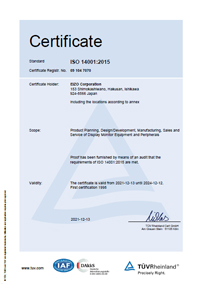
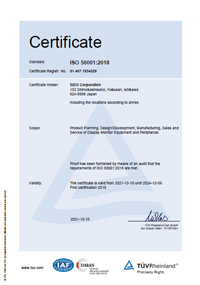
At each operational site, we have implemented an Environmental and Energy Management System to set, implement, evaluate, and continuously improve environmental and energy objectives. Group manufacturing sites, where environmental impact is highest, have obtained ISO 14001 and ISO 50001 certification.
ISO 14001 Certification Status
ISO 14001 coverage of EIZO Group manufacturing companies: 100% in Japan, 75% overseas
| Site | Scope |
|---|---|
| EIZO Corporation Headquarters | Product planning, design / development, manufacturing, sales and service of display monitor equipment and peripherals |
| EIZO Corporation Tokyo Sales Office | Sales of display monitor equipment and peripherals |
| EIZO Corporation Nagoya Sales Office | Sales of display monitor equipment and peripherals |
| EIZO Corporation Hokuriku Sales Office | Sales of display monitor equipment and peripherals |
| EIZO Corporation Osaka Sales Office | Sales of display monitor equipment and peripherals |
| EIZO Corporation Fukuoka Sales Office | Sales of display monitor equipment and peripherals |
| EIZO Corporation Sendai Sales Office | Sales of display monitor equipment and peripherals |
| EIZO Corporation Hiroshima Sales Office | Sales of display monitor equipment and peripherals |
| EIZO Corporation Sapporo Sales Office | Sales of display monitor equipment and peripherals |
| EIZO Corporation Takamatsu Sales Office | Sales of display monitor equipment and peripherals |
| EIZO MS Corporation Head Office / Hakui Factory | Manufacturing of display equipment and peripherals, manufacturing of printed circuit boards |
| EIZO MS Corporation Nanao Factory | Manufacturing and repair of display equipment and peripherals |
| EIZO Display Technologies(Suzhou) Co., Ltd. | Manufacturing, sales and repair of display monitor equipment and peripherals |
| EIZO GmbH | Manufacturing, sales and repair of display monitor equipment and peripherals |
| EIZO Technologies GmbH | Manufacturing, sales and repair of display monitor equipment and peripherals |
ISO 50001 Certification Status
| Site | Scope |
|---|---|
| EIZO Corporation Headquarters | Product planning, design / development, manufacturing, sales and service of display monitor equipment and peripherals |
| EIZO MS Corporation Head Office / Hakui Factory | Manufacturing of display equipment and peripherals, manufacturing of printed circuit boards |
| EIZO MS Corporation Nanao Factory | Manufacturing and repair of display equipment and peripherals |
EIZO Group Environmental Targets
Climate Change
GHG Reduction Targets
| KPIs | FY2024 | FY2025 | FY2026 | FY2030 | |
|---|---|---|---|---|---|
| Targets | Results | Targets | Targets | Targets | |
| Reduction of Scope 1 and 2 (compared to FY2019) | -58% | -62.2% | -59% | -61.5% | -70% |
| Reduction of Scope 3(Category 1 and Category 11) (compared to FY2019) | -12.5% | -32.2% | -15.0% | -17.5% | -27.5% |
Energy Conservation Targets
| KPIs | FY2024 | FY2030 | ||
|---|---|---|---|---|
| Targets | Results | Targets | ||
| Percentage of renewable energy used | Electricity (%) | 67% | 70% | 92% |
| Total Energy (%) | - | 53% | 80% | |
| KPIs | FY2024 | FY2030 | ||
|---|---|---|---|---|
| Targets | Results | Targets | ||
| Total Energy Consumption (MWh) | - | 16,862 | 17,900 | |
| Renewable Energy Consumption (electricity) (MWh) | - | 8,893 | 1,200 | |
| Non-renewable Energy Consumption (electricity) (MWh) | - | 3,759 | 2,300 | |
| Non-renewable Energy Consumption (fuel and heat) (MWh) | - | 4,210 | 17,900 | |
Circular Economy and Biodiversity
Product-Related Targets
| KPIs | FY2024 | FY2025 | FY2026 | FY2030 | |
|---|---|---|---|---|---|
| Targets | Results | Targets | Targets | Targets | |
| Use of halogen-free materials* *Percentage of halogen-free materials in the purchased mass of printed circuit boards, cables, harnesses and plastic parts weighing 25 g or more. | 83% | 79.5% | 83% | 85% | 90% |
| Use of recycled plastics in products | ・25% ・Use of high recycled content plastics in newly developed models | ・27.9% ・Use of high recycled content plastics in newly developed models |
・38% ・Continued use of high recycled content plastics in newly developed models |
45% | 70% |
| Use of paper material packaging | ・25% ・Use of paper packaging in newly developed models | ・30.1%% ・Use of paper packaging in newly developed models |
・25% ・Continued use of paper packaging in newly developed models |
55% | 80% |
GHG Redction Targets
| KPIs) | FY2024 | FY2025 | FY2026 | FY2030 | |
|---|---|---|---|---|---|
| Targets | Results | Targets | Targets | Targets | |
| Reduction of Scope 1 and 2 (compared to FY2019) | -58% | -62.2% | -59% | -61.5% | -70% |
| Reduction of Scope 3(Category 1 and Category 11) (compared to FY2019) | -12.5% | -32.2% | -15.0% | -17.5% | -27.5% |
Waste Reduction Targets (All Facilities)
| KPIs | FY2024 | FY2026 | FY2030 |
|---|---|---|---|
| Results | Targets | Targets | |
| Waste Generated per Unit Produced (vs FY2019) | +13.9% | -3% | -15% |
Water Usage Reduction Targets (Production Facilities)
| KPIs | FY2024 | FY2026 | FY2030 |
|---|---|---|---|
| Results | Targets | Targets | |
| Reduction in Water Usage (vs FY2023) | +3.2% | Consider measures | -5% |
| Water usage(m3) | 32,832 | - | 30,200 |
Pollution Prevention Targets (All Facilities)
| KPIs | FY2024 | FY2025 |
|---|---|---|
| Results | Targets | |
| Total amount of air pollutants excluding GHGs | Cleaning agents such as alcohol: 1.3t | Continue to monitor the usage |
| Discharge of wastewater | Our drainage system consists solely of domestic wastewater from toilets, sinks, and similar sources. Although a small amount of chemicals are used in the production process, strict leakage control measures ensure that none are discharged into the soil. | Achieve zero discharge of pollutants by managing them thoroughly |
| Total amount of pollutants released into the soil | Only a small amount of chemicals are used in the production process. However, strict leak management ensures that none are discharged into the soil. | Achieve zero discharge of pollutants by managing them thoroughly |