
Spirit of Manufacturing
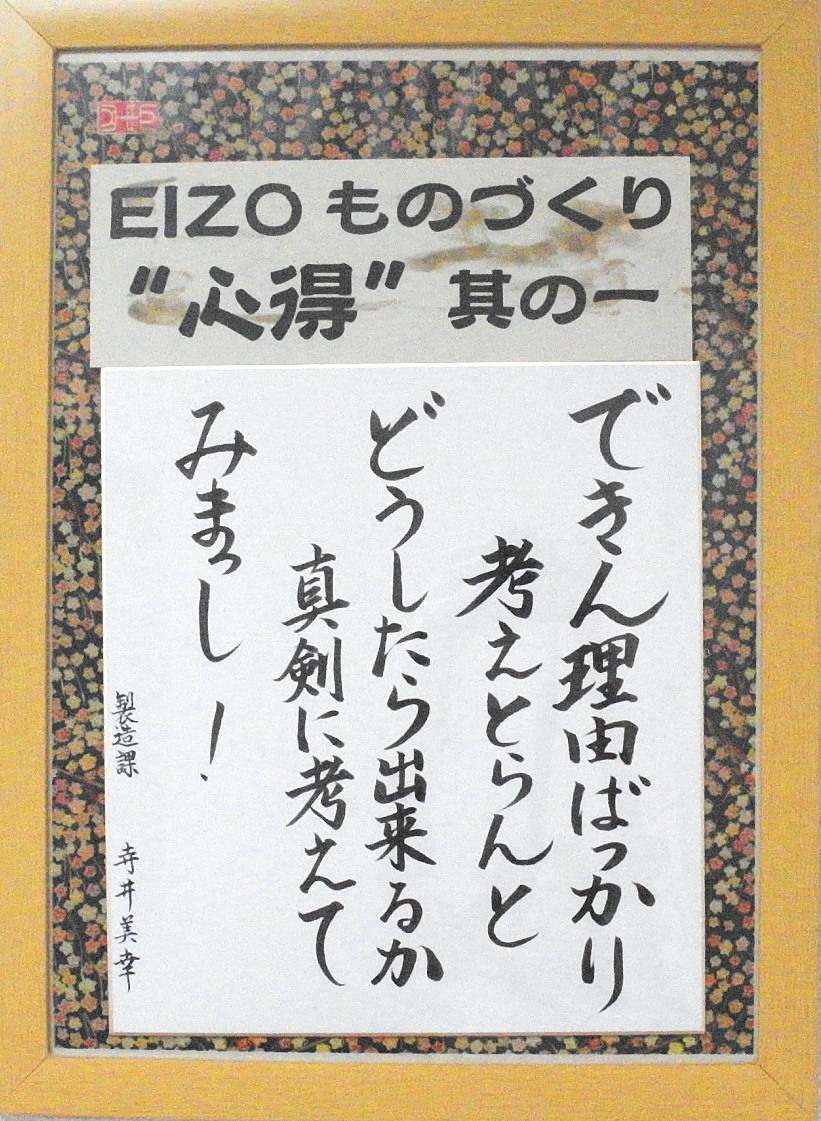
Stop looking for the reasons why you cannot do it. Think seriously how you can do it!” This statement originates from an EIZO production site and is now widely shared as the philosophy of EIZO's manufacturing.
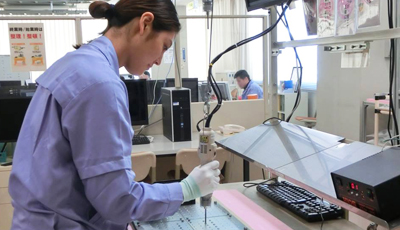
Each and every employee embodies this philosophy, taking pride in their work.
Integrated Group Production as EIZO's Proven Strengths
Our monitors are manufactured within the group in an integrated manner, from manufacturing of electronic circuit boards to assembly and inspection of finished products. Close alignment among all the teams and their united pursuit of ever-improved manufacturing have allowed EIZO to create products that reflect the world's first-class quality and reliability. More than 90% of circuit boards mounted on EIZO's monitors are manufactured at the Hakui Factory of EIZO MS Corporation and supplied to the assembly factories of the EIZO Group in Japan, China, and Germany.
At each factory, our R&D and manufacturing departments work together from the development stage, freely exchanging ideas for improving manufacturing operations. In addition, our Information Systems Department joins to analyze the massive volume of quality data accumulated daily in the production process. This is to ensure the data is fully used to constantly improve the development of new products, production systems, and process design. Moreover, our agile and stable procurement function optimizes the manufacturing process regardless of ever-changing market demand and material availability.
The EIZO Group's manufacturing strengths and competitive power are built on a strong sense of unity across departments and countries.
The Spirit of Manufacturing and Technologies
We have consistently incorporated state-of-the-art technologies into EIZO products, which requires the continual refining of our manufacturing expertise and skills. Thus, we provide regular training to all workers at our production sites to continually improve their skills. We also organize annual factory tours for employees of our group companies to share EIZO's manufacturing spirit and technologies globally.
Manufacturing Circuit Boards Meeting High Quality Standards
To maintain high quality standards in the mounting of sing the human eye.
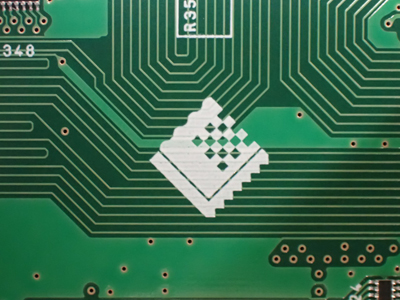
electronic components, the latest equipment is used to adjust the mounting position at micron levels. X-ray inspection prevents defective components from leaving the line by checking areas that cannot be inspected visually, and automated optical inspection confirms the mounting status of all components. The EIZO logo is firmly printed on all circuit boards made to represent the high reliability of our monitors.
Advanced Production Facilities Using AI, Robotics, and IoT
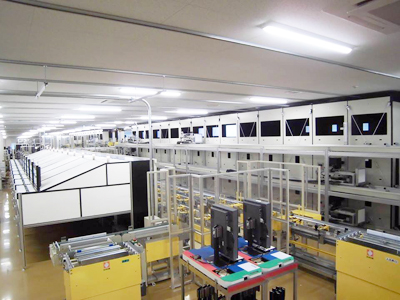
Approximately 80% of EIZO monitors worldwide are produced at EIZO Corporation's headquarters factory and EIZO MS Corporation's factory. These sites use four different production methods, depending on product characteristics, required production volumes, and delivery date requirements. The hybrid production has a state-of-the-art production line that has achieved labor saving and automation by taking advantage of AI, IoT, and robotics. This production system collects data in real time such as production progress, the operating status of equipment and measuring instruments, and the state of product adjustment. Analyzing this big data supports continual improvements in product quality and processes. In addition, we have achieved the digitization of onsite records using electronic paper and tablet terminals at production sites. We are striving to further improve productivity by accelerating data analysis.
| Production Type | Products Produced |
|---|---|
| Belt conveyor production | Products for business applications with high production volume per model (mainly B&P) |
| Cell production | Various products in small lots for specific markets (mainly V&S), each product requiring different adjustments and inspections |
| Hybrid production | Products that are difficult to adjust and therefore time intensive because of the many adjustment and inspection items (mainly healthcare and creative work). Two-thirds of the entire process can be fully automated. |
| Master production | Products with our uniquely customized panels (mainly V&S) The floor has a large clean room and specialized equipment |
Introducing Additional Automation Equipment, Resulting in a 30% Increase in Productivity
The strength of our 100% in-house development and production is deployed in the company's production process, the frontline of manufacturing—for example, in the recently launched automated function validation process and automated unit assembly process at the Hakui Factory. The board assembly for B&P products, which handles high volume production, is automatically performed in these processes.
Efficiency has increased by 30% compared to earlier manual processes, thereby boosting EIZO's productivity. The evolution of this production system is the result of the concerted efforts between the teams of manufacturing and development related to standardization of circuit board specs and circuit designs and reflects the competency of EIZO's factories.
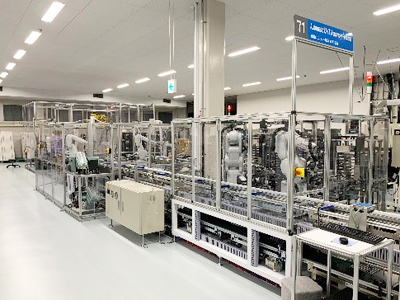
Clean Room/Bonding Facilities
For endoscope monitors and marine monitors, we use bonding technology to produce products with our unique panel processing. This requires a high level of cleanliness in the production environment, so we have installed an ISO CLASS 1* clean room in our factory, which is the world's highest standard.
*ISO CLASS 1... The highest class in clean room air cleanliness as defined in ISO 14644-1. A room called a "super clean room" (number of particles of 0.1μm (pcs/m3): 10 or less)
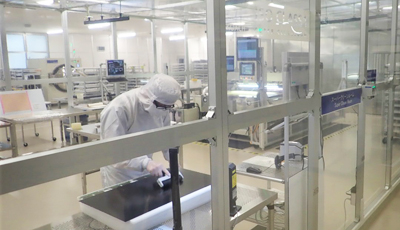
Inspection System for Catching Even the Smallest Abnormalities
We perform a thorough visual inspection for every single finished item, although automation has been employed for much of the production process. After going through automated inspection processes, such as color consistency and brightness uniformity on screens, the final image quality inspection is conducted visually by the staff who have been certified in-house. Monitors are products that people constantly stare at, so we believe in the importance of inspection using the human eye.
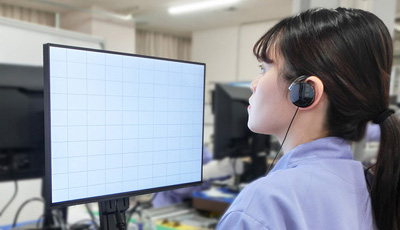
Worker Skill Development System
All workers assigned to production sites are trained at the Technical Skills Training Center. The training covers a wide range of topics, from understanding the structure of monitors to practical training in assembly.
The education and practical experience and skills of all workers are managed as skill charts, which are used as indicators for assigning the right person to the right job and as target indicators for each person to achieve multi-skilling.