

Director Nomination and Remuneration
Nomination and Remuneration Advisory Committee - Involvement of Independent External Directors
We have established the Nomination and Remuneration Advisory Committee as a voluntary committee to ensure transparency and objectivity in matters relating to the nomination policy and the appointment and dismissal of Directors as well as in decisions on the remuneration system and the amount of remuneration received by Directors (excluding those who serve as member of the Audit and Supervisory Committee). The majority of the members of the Nomination and Remuneration Advisory Committee are Independent External Directors who are appropriately involved in the decision making process of the Board of Directors, a process through which their opinions are reflected.
Policies & Procedures for Director Nomination
EIZO's policy is to nominate individuals with outstanding management capabilities, experience, integrity, and insight as candidates for Director. In addition, candidates for External Director must satisfy the Company's Criteria for Independence for External Directors and be capable of providing audits, oversight, and supervision of management and business execution from diverse and independent perspectives. Based on these principles, Director candidates are determined by the Board following deliberation and recommendations from the Nomination & Remuneration Advisory Committee. Candidates for Directors serving as Audit and Supervisory Committee Members are nominated with the consent of the Audit and Supervisory Committee. In determining Board composition, EIZO seeks an appropriate balance of knowledge, experience, expertise, and diversity, taking into consideration the Company's size, business characteristics, and strategic direction. EIZO appointed its first female Director in FY2022 and its first non-Japanese Director in FY2023. The Nomination & Remuneration Advisory Committee also advances succession planning for the CEO and other key management positions through ongoing deliberations. Following these discussions, the Board resolved changes in the Representative Director positions in March 2026. As a result, EIZO transitioned to a new management structure following the conclusion of the 59th Annual General Meeting of Shareholders held on June 23, 2026.
Note: The reasons for the appointment of each Director and the Company's criteria for Independence for External Directors are disclosed in the Reference Documents for the relevant Annual General Meeting of Shareholders.
Policy for Director Remuneration
The Board of Directors of the Company shall adopt a resolution on the policy for determining the content of remuneration, etc., for individual directors. Before making the resolution, the Company consults the Nomination and Remuneration Advisory Committee on the details of the resolution and receives its report. In addition, the Company has been reviewing its executive remuneration system, and following a resolution passed at the 55th Ordinary General Meeting of Shareholders (held in June 2022), share-based remuneration was introduced for executive directors. We will provide incentives to sustainably increase corporate value and promote further value sharing with shareholders.
Basic Policy
The Company’s basic policy is to set the remuneration of Directors at an appropriate level based on the responsibilities and duties of each Director, taking into consideration the following items. The remuneration system shall consist of fixed remuneration, performance-linked remuneration (both as monetary remuneration), and stock-based remuneration as non-monetary remuneration. Performance-linked remuneration and stock-based remuneration shall be paid to Executive Directors.
- 1) Motivation for medium- to long-term corporate growth of the Company and sustainable enhancement of corporate value
- 2) Role to fulfill corporate social responsibility
- 3) Business environment, performance, and execution of duties
- 4) Securing human resources with excellent management skills
- 5) The Company's business content and scale
The method of determining remuneration, etc., and the level of remuneration for each position shall be set forth in internal rules to be decided by the Board of Directors after deliberation and report by the Nomination and Remuneration Advisory Committee, in which Independent External Directors constitute the majority. The specific amount to be paid and the number of shares to be granted for each fiscal year shall also be determined to the extent determined by the Board of Directors after deliberation and report by the Nomination and Remuneration Advisory Committee in accordance with the relevant internal rules. In addition, the remuneration system and remuneration levels, etc., shall be reviewed in a timely and appropriate manner in response to changes in the business environment and other factors.
Policy for determining the amount of remuneration, etc., by an individual for fixed remuneration (monetary remuneration), including policy for determining the timing or conditions of granting remuneration
The basic remuneration of the Company’s Directors shall be a monthly fixed remuneration, which shall be determined in accordance with their position, responsibilities, and years in office, taking into consideration the standards of other companies, the Company's performance, and the level of employee salaries, as well as other factors in a comprehensive manner.
Policy for determining the details and calculation method of the amount or number of performance-linked and non-monetary remuneration, etc. (including policy for determining the timing or conditions of granting remuneration)
The Company's performance-linked remuneration and non-monetary stock-based remuneration shall each consist of the following.
1) Performance-linked remuneration shall be based on the amount of consolidated operating income for the fiscal year for which it is paid, in order to motivate Directors to improve their performance and to appropriately reflect the results of each fiscal year. The amount of performance-linked remuneration shall be calculated by multiplying 2% of consolidated operating income by the number of points stipulated in the internal rules for each position of Executive Directors eligible for payment. However, the maximum total amount shall be 150 million yen. Performance-linked remuneration shall not be paid if the ratio of consolidated operating income to net sales is less than 2% or if the amount of consolidated net income is less than 1,000 million yen. The calculated amount of performance-linked remuneration shall be paid as Directors' bonuses each year after the Ordinary General Meeting of Shareholders, following the end of the fiscal year.
From FY2026, a portion of performance-linked compensation shall consist of ROE-linked compensation based on ROE (Return on Equity) evaluation indicators. The amount of ROE-linked compensation shall be determined by applying a prescribed coefficient corresponding to the level of ROE to the amount calculated in accordance with the performance-linked compensation described above. However, if ROE for the applicable fiscal year is less than 5%, no ROE-linked compensation shall be paid.
2) Stock-based remuneration shall be granted to Executive Directors who are determined by the Board of Directors as restricted stock with a certain Transfer Restriction Period in order to share value with shareholders and to provide an incentive to continuously improve corporate value. The total amount and total number of shares of stock-based remuneration per fiscal year shall be determined by the Board of Directors, with a maximum amount of 50 million yen and 40,000 shares (after stock split adjustment as of October 1, 2024). The specific amount of stock-based remuneration shall be calculated based on the points stipulated in the internal rules for each position of Executive Directors who are eligible for payment. The number of shares to be granted shall be calculated based on the trading price on the stock exchange so that the amount to be paid per share will not be particularly favorable to the Executive Directors. The timing of the granting of stock-based remuneration shall be determined by a resolution of the Board of Directors after the Ordinary General Meeting of Shareholders. Directors who have been granted shares of stock shall not transfer, grant a security interest in, or otherwise dispose of such shares until they retire from their positions as Officers or employees of the Company or its group companies, as previously determined by the Board of Directors.
From FY2025, a portion of stock-based compensation shall consist of ESG-linked compensation based on ESG evaluation indicators. The evaluation items, comprising employee engagement (Social), environmental impact reduction targets including carbon neutrality (Environmental), and evaluations by external rating agencies (Governance), all of which are key performance indicators (KPIs) related to the Company’s materiality (key issues), shall be defined as indicators, and the level of achievement for each item shall be assessed for each fiscal year, based on which the amount of ESG-linked compensation is determined.
Policy on determining the ratio of the amounts of fixed remuneration, performance-linked remuneration, and stock-based remuneration to the amount of remuneration, etc., for individual Directors
Performance-linked remuneration shall be based on the amount of consolidated operating income for the fiscal year for which the remuneration is paid, and the higher the position, the higher the weight of the performance-linked remuneration. The Board of Directors will determine the appropriate allocation of stock-based remuneration as long-term incentive remuneration. The specific calculation method of the amount of performance-linked remuneration and the amount of stock-based remuneration is as described in c. above. Depending on performance, the ratio of performance-linked remuneration to the total amount of fixed remuneration, performance-linked remuneration, and stock-based remuneration (total amount of remuneration) generally ranges from 0% to 50% (of which approximately 0% to 7% is ROE-linked compensation), and the ratio of stock-based remuneration to the total amount of remuneration generally ranges from 0% to 25% (of which approximately 0% to 5% is ESG-linked compensation).
Other important matters concerning the determination of the details of remuneration, etc. for individual Directors
The details, calculation method, and amount of remuneration, etc., for each individual Director shall all be in accordance with internal rules established by the Board of Directors after deliberation and report by the Nomination and Remuneration Advisory Committee. The determination of the specific amount of fixed remuneration for each individual shall be delegated to and finally determined by the CEO in accordance with the relevant internal rules. The scope of delegation to the CEO shall be determined by the Board of Directors, subject to the report of the Nomination and Remuneration Advisory Committee.
Procedures for Director Remuneration
The method for determining remuneration and related matters as well as remuneration criteria by rank are set forth in the internal regulations, which are determined by the Board of Directors after deliberating with and recommendations from the Nomination and Remuneration Advisory Committee. The specific amount to be paid for each fiscal year is also determined in accordance with the relevant internal regulations and within the scope determined by the Board of Directors after deliberating with and receiving the recommendations from the Nomination and Remuneration Advisory Committee. The Audit and Supervisory Committee holds discussions on the remuneration system, method of calculation, and amount of remuneration for Directors who are members of the Audit and Supervisory Committee.
Incentives
For Directors with executive responsibilities, EIZO introduced Performance-based Remuneration (monetary) linked to consolidated Operating Profit as a short-term incentive and Stock-based Remuneration (non-monetary) as a long-term incentive in FY2022. From FY2025, EIZO introduced an ESG-based component within Stock-based Remuneration to further promote initiatives addressing the Company's Materiality issues and enhance value sharing with stakeholders. This component is based on ESG performance indicators. From FY2026, EIZO introduced an ROE-based Remuneration component within Performance-based Remuneration. By linking improvements in ROE directly to the evaluation and remuneration of executive Directors, the Company seeks to strengthen accountability for capital efficiency. In addition to consolidated Operating Profit, the use of ROE as a performance indicator encourages management decisions that balance profit creation and effective capital utilization.
Director Remuneration Structure
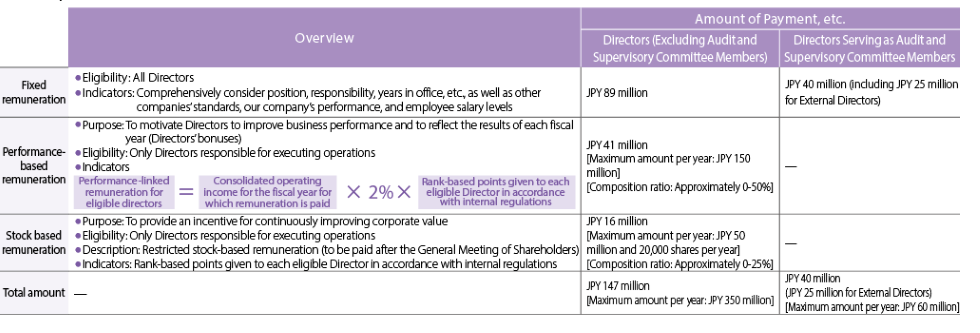
Remuneration Structure for Executive Directors


