

Risk Management
Corporate Policy
We have established and are operating an Enterprise Risk Management system to manage risks in an integrated and unified way at the head office, recognizing that the appropriate management of risks surrounding the EIZO Group is essential for achieving management goals and implementing business strategies.
Enterprise Risk Management System
① Organizing and confirming risks by the Risk Management Committee
We established the Risk Management Committee in accordance with the Basic Regulations on Risk Management and hold meetings twice a year during the first and second half of each fiscal year. In the first meeting, the committee narrows down important risks from those collected from each department and confirms and organizes the details and countermeasures. In order to identify risks to our business in a timely and effective manner, we have improved the comprehensiveness and efficiency of our risk collection process by integrating it with the departmental goal management system. In addition, the committee centrally grasps the risks of overseas Group companies through individual interviews with each company.
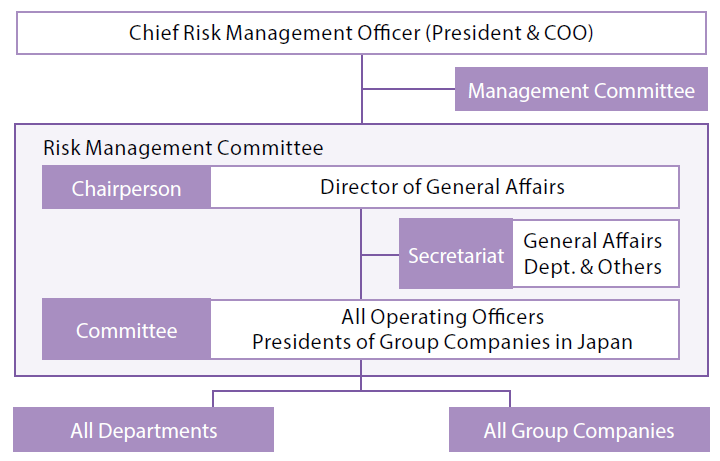
② Determining important risks by the Management Committee and implementing measures by each department
The Management Committee deliberates on the details confirmed and organized by the Risk Management Committee and identifies the key risks affecting Group management. Key risks are communicated Group-wide through the head of each department and necessary measures (reduction, retention, avoidance, and transfer) are undertaken by the relevant departments.
③ Grasping the risks for the next fiscal year
In the second meeting, the Risk Management Committee confirms the details and progress of our response to each risk and identifies risks that will continue to require attention in the following fiscal year. We also reflect those risks in the planning of our management objectives and plans for the following year.
Business-related RisksBusiness Continuity Plan (BCP)
To proactively prepare for the potential impact of major disasters, we have formulated and thoroughly disseminated a BCP throughout the company. Specifically, our Disaster Response BCP addresses preparedness in normal times, procedures for confirming the safety of employees, and facilitating necessary rescue operations in the immediate aftermath of a major disaster and within one month to restore at least critical operations, and resume delivery of our products.
Responsibility for Stable Supply of Products
Our products support social infrastructure such as the Healthcare and V&S markets, and we recognize that the stable supply of our products is a commitment to the markets. The risk of parts/raw material procurement is evident due to natural disasters such as typhoons and heavy rains and unexpected situations such as infectious diseases, as well as the tight global supply and demand for semiconductors and supply chain disruptions. We minimize the impact on the stable supply of our products through the following efforts to address these risks.
- Continuously confirm BCPs with procurement suppliers
- Strategically increase inventory of parts/raw materials and finished goods inventory
- Multiply parts suppliers, factories, and raw materials from the design stage, and pre-certify substitutes
- Taking advantage of 100% in-house R&D and production for flexible engineering changes


