

Materiality and Identification Process
EIZO's Materiality
The Sustainability Committee has identified EIZO's materiality and key issues from a sustainability perspective as follows.
EIZO's Materiality and Key Focus Point
| EIZO's Materiality | Key Focus Points | Related SDGs | |
|---|---|---|---|
| S | Contribute to the creation of a prosperous society through imaging solutions |
|
|
| Broadminded corporate culture that encourages free and creative activity |
|
|
|
| Respect human rights and diversity |
|
|
|
| Supply Chain Management |
|
|
|
| E | Respond to Climate Change |
|
|
| Supporting a Recycling-Oriented Society |
|
|
|
| G | Open and Fair Governance |
|
|


Identification Process
From a sustainability perspective, the Company conducted a double materiality assessment in line with the implementation guidance published by EFRAG*1 in order to identify sustainability matters that are important to the Company. Although the Company is not subject to CSRD*2, this assessment was undertaken as part of its strategic sustainability management, based on its commitment to achieving long-term value creation and sustainable growth with due consideration to society and the environment. Based on the results of these analyses, the Company ultimately identified the materiality that it should address.
- *1 EFRAG (European Financial Reporting Advisory Group)
- *2 CSRD (Corporate Sustainability Reporting Directive)
STEP 1. Topic Identification
To gain an overall understanding of the Company’s business activities, we organized our value creation process, key activities, and relationships with stakeholders. Based on this analysis, we identified candidate topics that are considered highly relevant to the Company by referring to the following frameworks and initiatives:
- ESRS*3
- SDGs
- United Nations Global Compact Ten Principles
- GRI Standards
- TCFD / TNFD reports
- ISSB*4 / SSBJ*5 etc.
- *3 ESRS (European Sustainability Reporting Standards)
- *4 ISSB (International Sustainability Standards Board)
- *5 SSBJ (Sustainability Standards Board of Japan)
STEP 2. Identification of IROs (Impacts, Risks, and Opportunities)
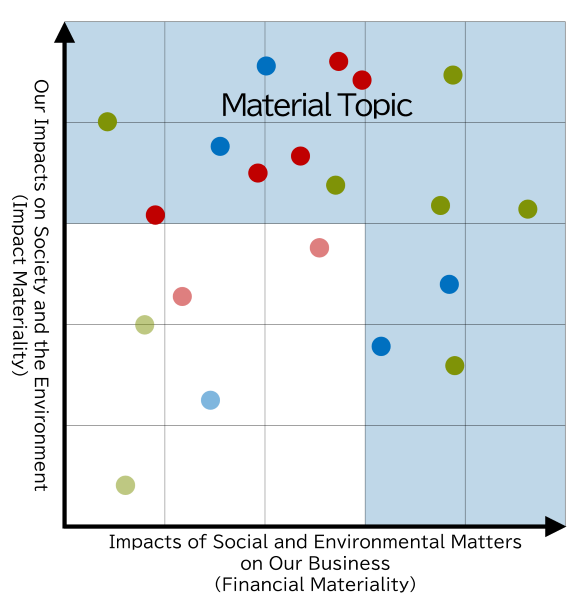
Based on the requirements of ESRS and other relevant standards, and in accordance with the concept of double materiality, we identified Impacts, Risks, and Opportunities (IROs) related to ESG topics, including both the impacts of the Company’s business on society and the environment (impact materiality) and the risks and opportunities arising from the impacts of society and the environment on the Company’s business (financial materiality).
STEP 3. Evaluation of IROs
For the impacts, risks, and opportunities identified in Step 2, evaluation criteria were established from the perspective of double materiality, and assessments were conducted accordingly. In addition to internal discussions, the evaluation also incorporated the perspectives of external stakeholders.
STEP 4. Identification of Material Topics
Based on the evaluation results in Step 3, the results were mapped onto a matrix, and 19 topics were identified as material topics.
STEP 5. Materiality Identification
The identified material topics were reviewed in light of the Company’s fundamental sustainability policy, the “EIZO Group Principles of Conduct,” and determined as the Company’s materiality. The materiality was deliberated by the Sustainability Committee, which operates under the Board of Directors, and subsequently approved by the Board of Directors.
Going forward, the Sustainability Committee will continue to monitor progress using the PDCA cycle and review the consistency of the materiality on an annual basis. If revisions are deemed necessary, appropriate updates will be made and reported to the Board of Directors.
In addition, key focus points derived from the materiality analysis are utilized in the formulation of business risks. At the same time, based on newly identified or revised critical risks discussed by the Sustainability Committee, additions or revisions to the materiality are considered as necessary. In this way, materiality is closely linked with enterprise risk management (ERM) across the Company.


